Serenity Now

“Serene was a word you could put to Brooklyn, New York. Especially in the summer of 1912. Somber, as a word, was better. But it did not apply to Williamsburg, Brooklyn. Prairie was lovely and Shenandoah had a beautiful sound, but you couldn’t fit those words into Brooklyn. Serene was the only word for it, especially on a Saturday afternoon in summer.”

Last week, I packed my books. (I only own about a hundred; odd for a librarian, you say? Consider where I spend my days – surrounded by those paper friends, any of which I can bring home with me whenever I want!) One of the few books I own is one I’ve read probably a dozen times: A Tree Grows in Brooklyn. Its pages are yellowing and I long ago taped its back cover on; it’s weirdly full of typos and it smells musty and I love it. I love that I can dip into the narrative and know exactly where I am. It’s the book I read when I’m moving, because it’s always with me and it’s distracting and it doesn’t require my full attention. Unfortunately, I accidentally did the unthinkable and packed it. I tried to borrow a different book from the library, but I just couldn’t get into it, so I dug back into the stack of boxes and rescued my friend Francie. And now if you’ll excuse me, I have some reading to do!

VISAS

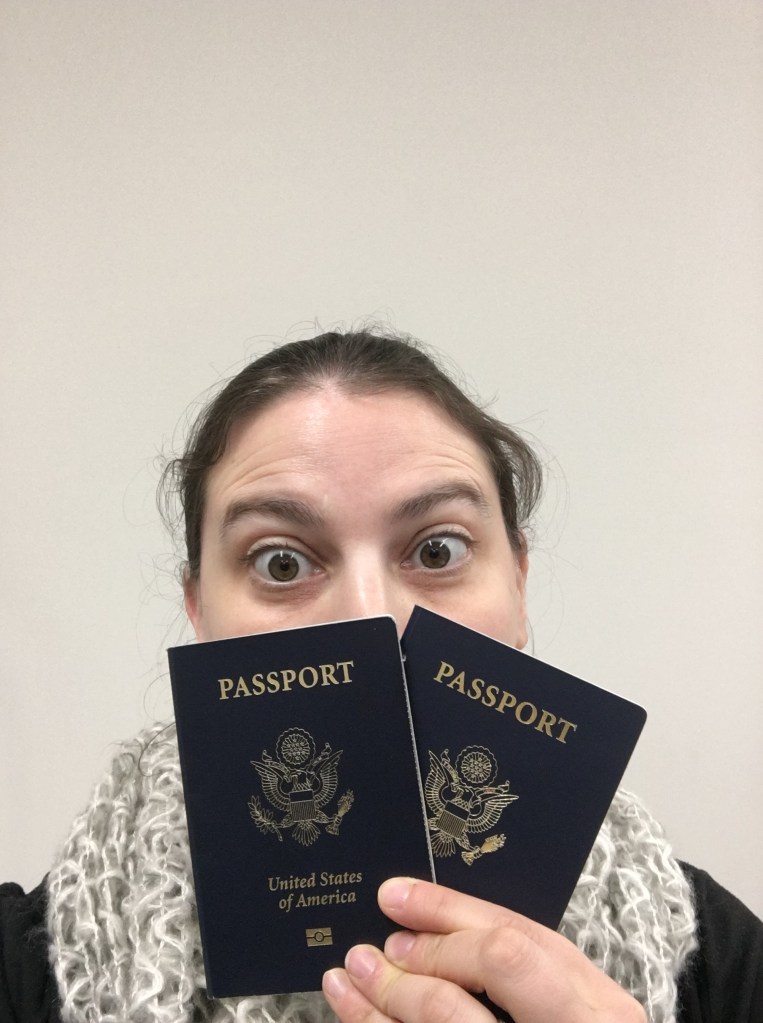
Our passports! With visas!

It’s real! They’re here! There’s no turning back! Thank God.

Tomorrow we’re off to the RMV to gift our car to a friend to babysit for the year; then to buy Duck a new laptop; then wedding dress shopping with another friend (yes, Duck will get to go; yes, he’s thrilled; yes, he will beg to hang out with her dog – our goddog – after).

And then? Back to our warren of boxes, aka our apartment. We made room in the basement storage unit the other day, pulling out empty boxes (bye-bye, stand mixer), adding full ones, and rearranging everything to maximize space. I gave Duck the challenge of cooking only from the pantry and fridge for dinner, and he did it! He would do quite well on those cooking shows where you have to use octopus in all your dishes – or in our case, half a jar of sundried tomatoes and the rest of the flour and walnuts. We made pasta with steamed carrots and spinach, plus carrot bread (Duck’s idea) and ravioli with roasted potatoes and brussels sprouts.

“And face unafraid, the plans that we’ve made…”

Happy Festivus! Up here in the northern hemisphere, this song has been running through my head. Though it’s hardly a winter wonderland in Boston (upper 40’s today), we’re apparently in for a big “wintry mix” soon. Meanwhile, it’s almost 80F (26C) degrees and thunderstorming in Belo Horizonte and I would be lying if I said I wasn’t drooling a little. (I love thunderstorms; Duck, not so much.) But mostly it’s been running through my head because we both have lots of fears about these plans that we’ve made, and it’s become a bit of a mantra for me.

After much hand-wringing and many setbacks, I put our bulging envelope of visa application stuff in the mail today! Duck held my hand last night as we went through the assembled documents and the various lists on the consulate’s website to make sure we had everything. Guys, I have never jumped through so many hoops for anything in my life, much less a visa. Birth certificates and marriage certificates, all certified and with apostilles, making them valid abroad; receipt pages from the 6-page online visa applications, signed and with a passport-sized photo glued to each; a document signed by Duck stating he was seeking a “family reunification” visa; my Grant Authorization Document from Fulbright; the name, address, and phone number of my host in Brazil; maybe application fees and FBI background checks? (no – yes – no, we do NOT need these); a Priority Mail SASE; passports; itinerary; proof of current address; the promise of our firstborn; all sent Express Mail, anything else will be rejected.

I remember from my time working and living in Australia that the visa process was the most stressful, but even that just required something comparatively simple in the first place and then to get the travel visa I just had to pop over to the office and it took half an hour. The Brazilian consulate in Boston does not allow phone calls or in-person visits; if our packet is missing something, we won’t know until it gets back to us, by which point we will REALLY be cutting it close. Can you tell I’m just a wee bit stressed out by this?

But the good news is, once we get our documents back, that’s the last really big, out-of-our-hands stumbling block. After that, we are good to go as far as the governments are concerned, and then we can get on with the fun stuff of packing! Did I say packing? I meant planning our pre-orientation honeymoon in Iguacu Falls!

The Hard and the Stressful

We are frantically trying to get our papers together to apply for the visa. Fulbright recommends doing this 60 days before your travel date; right now we are about 5-6 weeks out and even if everything gets expedited we won’t be able to submit everything until about 4 weeks out. Eeeek. The holdup is that it turns out both of us need to submit our birth certificates, with an extra certification called an apostille to make them valid abroad, so we’re working on getting Marc’s now and then we should be all set. It might require him to go to Albany for the birth certificate and then to NYC for the apostille, just to make sure we get everything in time. Yikes!

The other tricky thing right now is that I am trying to figure out how to get ethical approval for my research, because it will involve people filling out surveys and participating in focus groups. In June, I misread a message from my host in Brazil, Marilia, who had said that she thought I *did* need approval from the Committee of Ethics, if I were being funded by Brazil (I thought she said I did not need approval), but that I should check with the Americans since that is where my funding is coming from. I am kicking myself for the error, and for not realizing it for so long. (To be a little bit gentle on myself, the wedding derailed me, plus UFMG – Universidade Federal de Minas Gerais, my host institution – was on semester break until September.)

As far as I can tell, the Americans don’t really know what to tell me about ethical research approval. Normally, I think Fulbrighters are actively connected to their university here, and would go through their university’s IRB (Institutional Review Board), but I graduated 4 years ago. I sent an email to my school’s IRB training coordinator and am waiting to hear back. I will also email the Fulbright commission in Brazil (the American office already responded that they don’t deal with these issues) on Monday, but I’ve been emailing them frantically about visa stuff, so I’d rather give them a tiny break if I can.

The email from my host in Brazil was from June, so I’ve been sitting on this for a while. From what I’ve heard, IRB approval can take a long time, and we’re heading into the holiday season where people go on vacation for weeks at a time (especially with the semester break up here in the northern hemisphere), so I’m getting nervous. If it does end up taking a while to get approval, I should be able to get acclimated, get better at Portuguese, and do more preliminary work before the actual survey part starts. (According to my Statement of Grant Purpose, I wasn’t going to start formally surveying participants until April, anyway.) The last resort might be to go through UMFG for ethics approval, and Marilia is looking into that for me.

Fingers crossed that this all works out!
Stuffing and Festas and Shyness, Oba!

Deborah used the word oba to describe her Thanksgiving-Eve potluck party. “Oba?” I said. She replied, “É uma comemoração!” (it’s a celebration!). Google Translate tells me “oba” is an interjection sort of like “wow,” which seems like a useful word to know! I told her I would bring stuffing and we had a good time trying to translate that into Portuguese! (“Stuffing like in a couch?” “Yes – but you ‘stuff’ it into a turkey!” Her roommate eventually came up with a word for it that I have now forgotten.)

Deborah’s roommates are all Brazilian and it was fascinating as always to be a linguistic minority at the festa (party). A couple of other native English speakers were also there, and at least one Spanish-speaker, and most of the Brazilians I talked to seemed to know at least a little English. I forgot that I knew even basic pleasantries like “nice to meet you” (é um prazer conhecer você) – Spanish is so deeply entrenched that I kept wanting to say “mucho gusto” instead.

As I had experienced before, it was a lot of work to understand the rapid-fire conversation swirling around me, especially over the loud (but entertaining!) karaoke situation happening nearby. I also realized I need to practice saying things like, “can you repeat that” “more slowly please” etc.

But I made do and managed to have some conversations, though I left early and scurried through the rain back home and under the covers, where I could marvel yet again at my own mousiness in new and uncomfortable situations and try to let go of the fear that my shyness, poor language skills, and fear of looking foolish will prevent me from doing the work I want to do in BH. Duck was very helpful in responding to my panicky texts from the party and encouraging me to take “field notes” and talk it through with him after. He also reminded me that parties are basically the deep end of language learning pool, with lots of background noise, slang, and relaxed pronunciations, so I’m trying to let myself off the hook and praise myself for making conversation when I could. I am so, so grateful he’ll be with me; it will be so much less lonely and scary!

You Can’t Get There From Here

We had Duck’s Portuguese teacher and his wife over for dinner the other night and at some point, the topic turned to transportation. Allan had spent some time in Belo Horizonte and was giving us advice on getting around without a car. However, one of the things on our giant pre-Brazil to do list is to figure out what to do with our car, Vivian. While I doubt Viv would survive the bazillion-mile drive to Brazil, it piqued my curiosity and set me to googling how long it would take to drive there.

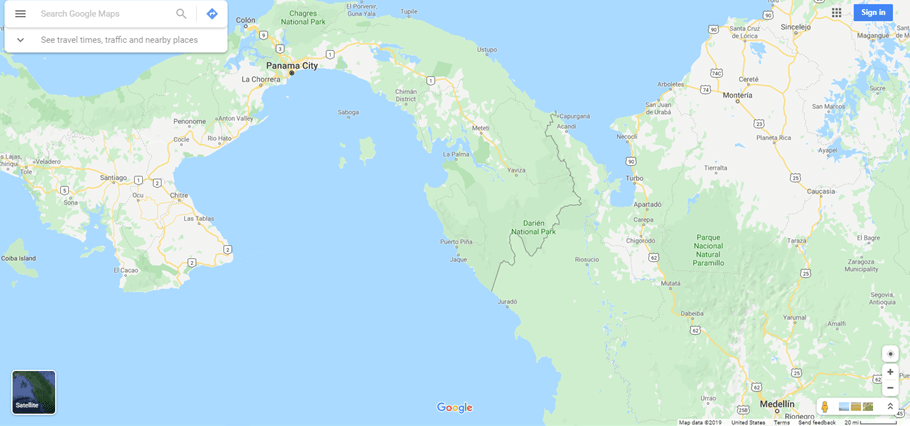
Unfortunately, this is not days of yore where Google Maps would give you driving directions from the U.S. to Japan by telling you to drive to the ocean and then paddle across it. This time, I got an error message saying that no route was available between Boston and Belo Horizonte. I tried fine-tuning various segments of the would-be drive until I narrowed down the problem: there is a section of green – solid forest, or jungle, or whatever is there – in southern Panama where there are no roads through to Colombia. Alas, we will not be driving Viv to Brazil.

But we are working on making our giant to do list! Now that things on the family front are feeling much more under control, we are able to take a deep breath and realize that we are only three months away from leaving, eeeek! So this morning I sat down and went through some of Duck’s flashcards. I often cycle through what the word is in Spanish before either remembering or looking at the word in Portuguese. Duck is better at the accent, and I’m overall better at the vocab because it’s often so close to the Spanish.

We’ll get there… one way or another!

(PS – If you’re curious, it’s 94 hours from Arlington, MA to Yaviza, Panama, and 123 hours from Apartado, Colombia to Belo Horizonte. Throwing in a few for the miles of forest to cover if there were a road there, and rounding up, we’ll say 240 hours, or 10 days if you drive straight through.)

(PPS – Also, I had real pão de queijo at Honk! a few weeks ago and it was delightful. I then proceeded to accidentally text the new landlord about it instead of Deborah, but she responded with interest so all’s well that ends well and I’m going to try to stop being embarrassed about it.)

Location, Location, Location

Things have been a little busy on the family front over here, so there hasn’t been much focus on preparations, but we did secure a place to live! I had reached out to someone who had done a Fulbright in BH a couple of years ago and who was a wealth of information. She gave me the name of the people she rented from, one of whom is a professor at the university I’ll be connected to. We had impeccably bad timing in getting back to her with a definitive “we’re interested” because another couple had indicated their interest just days before (we were waylaid with the family front issues) but I pushed the landlord and she gave the other couple a few more days to decide and then came back and offered it to us! So, yay! I’m a bit concerned it’s very small and basic, but it is furnished and the price is right so we’ll just see how it goes. It’s got a double bed, a small sofa and tv, and a kitchenette, with a pantry and oven space in a separate area. There’s also a second, separate bedroom that they rent out separately so we could theoretically rent that if/when people come visit (my mom practically has her plane tickets already!). It’s right between the university and the lake, and around the corner from a messianic Jewish congregation (too bad the synagogue I think we would actually attend is a 40-minute bus adventure away, downtown! but I think I’ll be spending a fair amount of time near there anyway because that seems to be where the public library is). We are very relieved to have that all set!

The other person I was in touch with is the other Fulbrighter who will be in BH. She will be coming with her husband and two kids – one of whom is in school, the other presumably not quite yet. We’ve exchanged a few emails and she seems very nice. Her husband is from BH and they will be living with his parents while they’re there, also near the university, so that’s a few more people to help us adjust and get settled. There’s still a lot to do before we go, but I’m getting encouraging emails from Fulbright about next steps (how to book flights, for example) – we’re getting excited!

Complainy Bread and Other Culinary Adventures

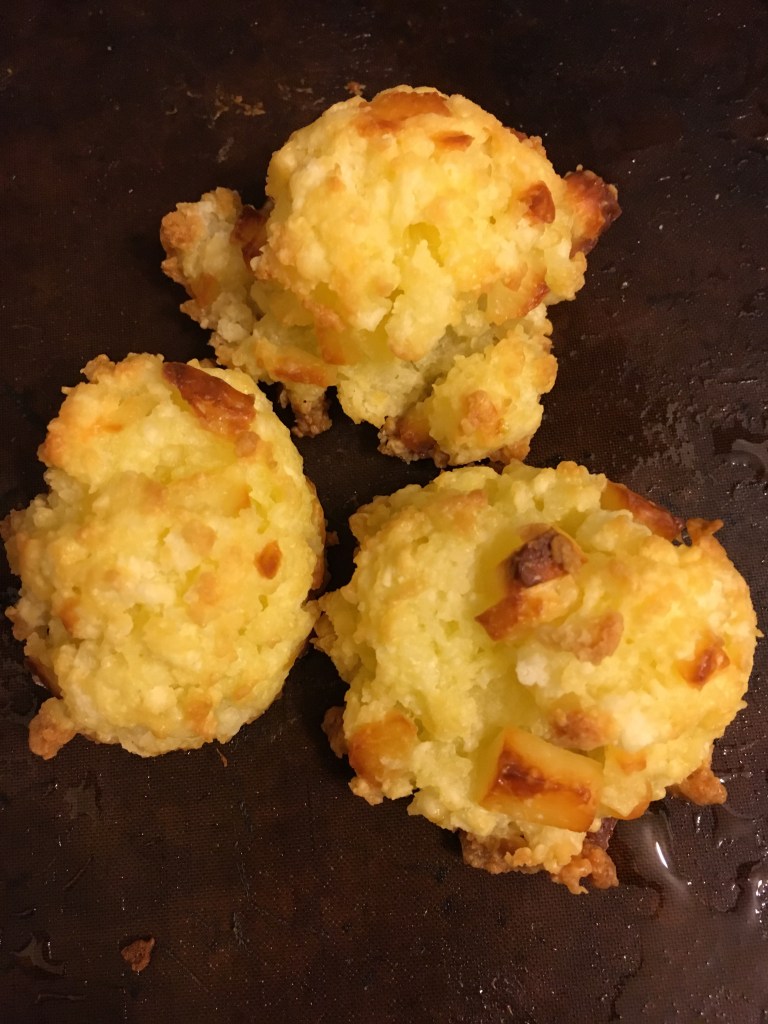
Pão de queijo

Following up on my earlier post, Uma introdução à comida (an introduction to the food), the other night I decided to try my hand at two dishes. One dish is called pão de queijo. If you know Spanish, you might not be surprised to learn that pão, like pan, means bread. Queijo, however, bears no resemblance to the Spanish word quejo, or complaint; its cognate is queso, which you might also know if you are a fan of nachos con queso – cheese! So pão de queijo means cheesy bread rolls (not complainy bread, as I was mis-translating it in my head). These are also naturally gluten-free, calling for tapioca flour instead of wheat flour, but of course my grocery store, which is famous for not having everything on my shopping list, like, ever, did not have tapioca flour. My gluten-free colleague, seeing me googling recipes at the computer next to him, advised to sub in cornstarch if I couldn’t find tapioca flour. I think I also overbaked them a bit, so they did not come out great the first time. When I went to do it again, I went out of my way to find tapioca flour (Whole Foods and its giant esoteric grain selection to the rescue!). I bet tapioca flour is easy to find in Brazil, given how ubiquitous these seem to be! The second batch was much lighter and tastier than the first.

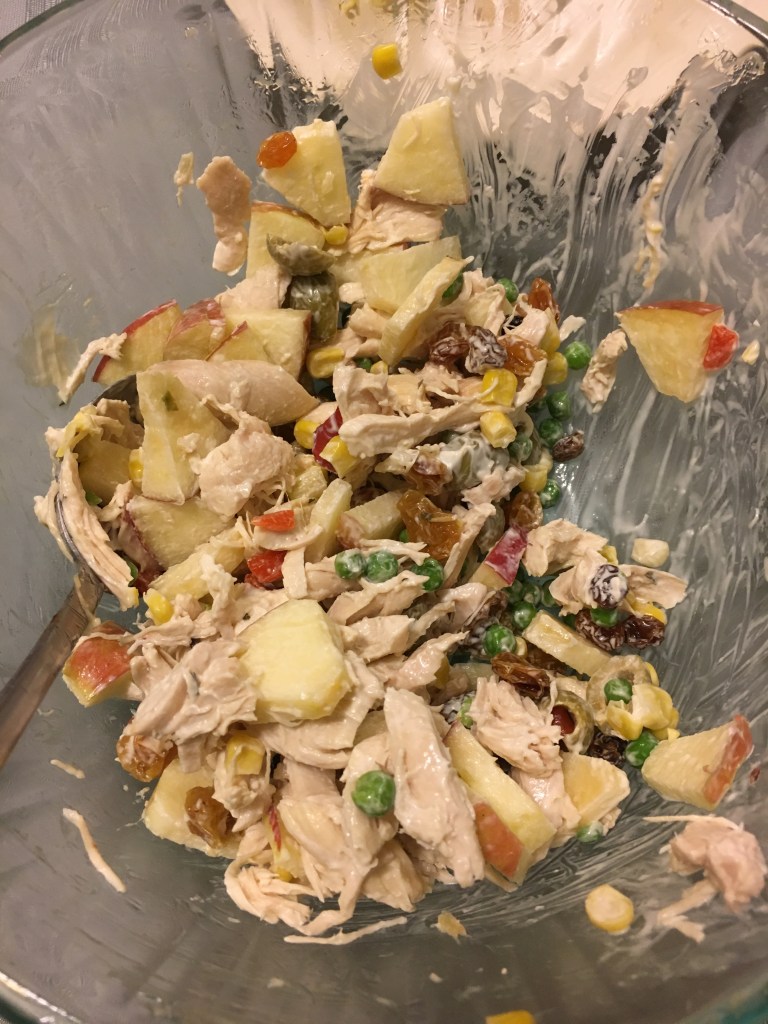
Salpicão

The other dish seemed like a good summery dish, salpicão (chicken salad), so I thought it would be good to make while the weather here in the northern hemisphere is still warm. I found lots of different versions of this; basically it seems like you can put in whatever you like, or whatever you have on hand. Ours had raisins, apple, peas, corn, and green olives, plus chicken and mayo (I generally distrust mayo-based salads, which goes against my Midwestern roots, but I digress – but this was good). I did poach – and shred – chicken for the first time, so that was new. All recipes also called for “shoestring potatoes” which I didn’t know by that name but are those super thin, very crunchy french fries. Unfortunately, my grocery store of course did not have shoestring potatoes, so I subbed in pistachios for a little crunch. (So sue me; it was fine.) Next time I have real salpicão, I won’t be too distrustful of its mayo-y nature!

Os livros para meninos

(Books for children)

Since I’ll be studying libraries and in particular how families use the library, I imagine I’ll be spending some significant time in children’s library spaces, so I figured I should get to know some children’s books. Unfortunately, my library doesn’t have too many that were originally written in Portuguese. I requested a few folk tales, especially as they might help with understanding the culture and references (the way Americans might refer to the sky falling or “and so she did” from the Little Red Hen story). Here are a few:

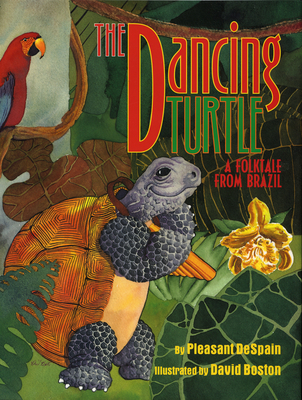
The Dancing Turtle: a folktale from Brazil by Pleasant DeSpain

Turtle loves to play her pan flute and dance. When she gets captured by a man, she tricks his children into letting her go by playing her flute and offering to show them her dance. Pleasant DeSpain seems to be one of those white writers who spend some time in another culture, are drawn to their stories, and write them down. On the one hand, I’m glad to be exposed to a whole world of stories without leaving my town, but on the other hand, sometimes these white writers get things wrong or sort of corner the market in a way that would best be handled by writers from that culture. It’s something we librarians as a profession need to be more aware of and it’s a phenomenon called #ownvoices.

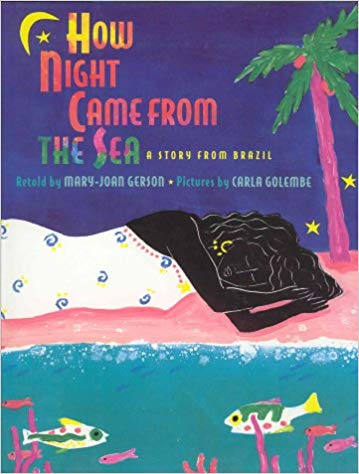
How Night Came From the Sea by Mary-Joan Gerson

Another white writer, this time retelling a fusion of African and Brazilian myths. This one is a how/why story of why we have day and night. Night comes from an African goddess of the sea whose daughter lives on land with her husband but gets exhausted by the light all the time, so her mother sends her the night creatures and then she can rest.

Jabuti the Tortoise by Gerald McDermott

Another trickster tale that is also a why/how story; also another one written by a white dude (here’s one perspective on critique of McDermott, if you’re curious – about his Caldecott win in 1975). Jabuti explains not only why turtle/tortoise shells are tiled, but also how some birds got their colorful feathers. Vulture agrees to give Jabuti a ride up to the party thrown by the King of Heaven, but he throws Jabuti off his back because he’s still annoyed about being tricked in the past. Jabuti falls to the ground and his shell shatters; the other birds come and help him get put back together and earn their colors.

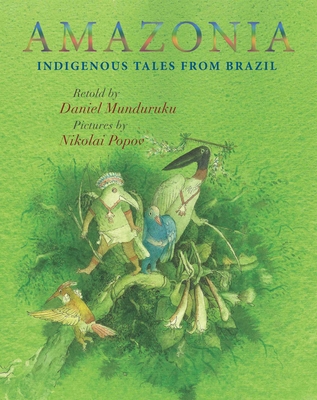
Amazonia: Indigenous Tales from Brazil, retold by Daniel Munduruku

This book does the best job of identifying the tribes of origin, which is perhaps not surprising as he is native himself. I also attribute the sense that the stories do not follow western storytelling patterns to the fact that they are authentically told. Some of these stories are how/why stories but some are harder for me as a non-Native person to follow. But I’ll keep an eye out for references to pequi and other foods, animals, and mythological characters while in Brazil!

The Great Snake: Stories from the Amazon by Sean Taylor

This is one of the worst offenders in terms of not attributing the stories to the indigenous tribe. The most egregious to me was this part: “…the unique mix of people who live here – native Brazilians… Europeans… and Africans shipped to South America as slaves. Their stories have mixed, like paints, to make new colours. The next tale is an example of this mix.” (Notice a complete lack of the horror and trauma inflicted by Europeans in their domination of the other two.)

BUT I feel like the large number of stories gave me a good foundation for some key terms and ideas that I might hear about in Brazil, even just in passing. Jurutai (a bird – the story told how the Amazon River came to be), Curupira (a small red-furred yeti-type fellow who watches to make sure you don’t hunt or cut trees for sport or money), Mani (an enchanted possibly albino girl, whence comes the name manioc), and river dolphins appearing as handsome young men.

Uma introdução à comida

(An introduction to the food)

When in doubt, a children’s librarian turns to… children’s books! I grabbed a book called Foods of Brazil by Christine Roholt from our children’s cooking section because I was curious about this famous feijoada dish. Duck and I have had several conversations about the food in Brazil, especially because I don’t usually eat pork or non-fish seafood for kosher reasons. I don’t keep full kosher, but I didn’t really grow up eating those foods, so to me they are just sort of foreign and icky and less about how kosher it is or isn’t. If someone served you octopus, you might be reluctant to try it if you didn’t grow up eating it, you know? Pork and seafood are like that for me.

HOWEVER. To celebrate getting the Fulbright, my friend Denise and I went to a Brazilian BBQ restaurant and I tried some of their sausage and oh. my. it was good. I have also instructed Duck on multiple occasions that when we are a guest in someone’s home and they serve me pig, he is not to make a big deal out of it. If I can, I will eat around it; if not, I will just eat it because I know how anxious and upset I feel as a host if I accidentally serve someone food they prefer not to eat (or are allergic to) and not upsetting people is more important to me than eating something that sort of grosses me out. The same principle applies in Brazil, plus Duck’s anthropological training of always try to say yes to things when out in the field. So I have been expanding my exposure to treyf (non-kosher foods) in preparation!

In my final conversation class this week, we talked about restaurants and food. Katia asked us what the most unusual thing we’ve eaten was (for me: kangaroo, crocodile, and buffalo; the French woman said, unsurprisingly, snails and tripe). She also asked us about our allergies, which is when I learned a term that will be useful to me: intolerância a lactose. Also apparently tips are included in the bill, and water is never free. If there is live music, you can add a tip for the musician(s).

Foods of Brazil surprisingly doesn’t cover feijoada, the famous stew, but does have pão de queijo (cheesy bread rolls), moqueca (fish stew), salpicão (chicken salad), and rabanaca (french toast), plus some background on the foods and eating customs in Brazil. I hope we can try out some of these recipes, and I’ll keep you posted on our culinary expeditions!

Design a site like this with WordPress.com
Get started